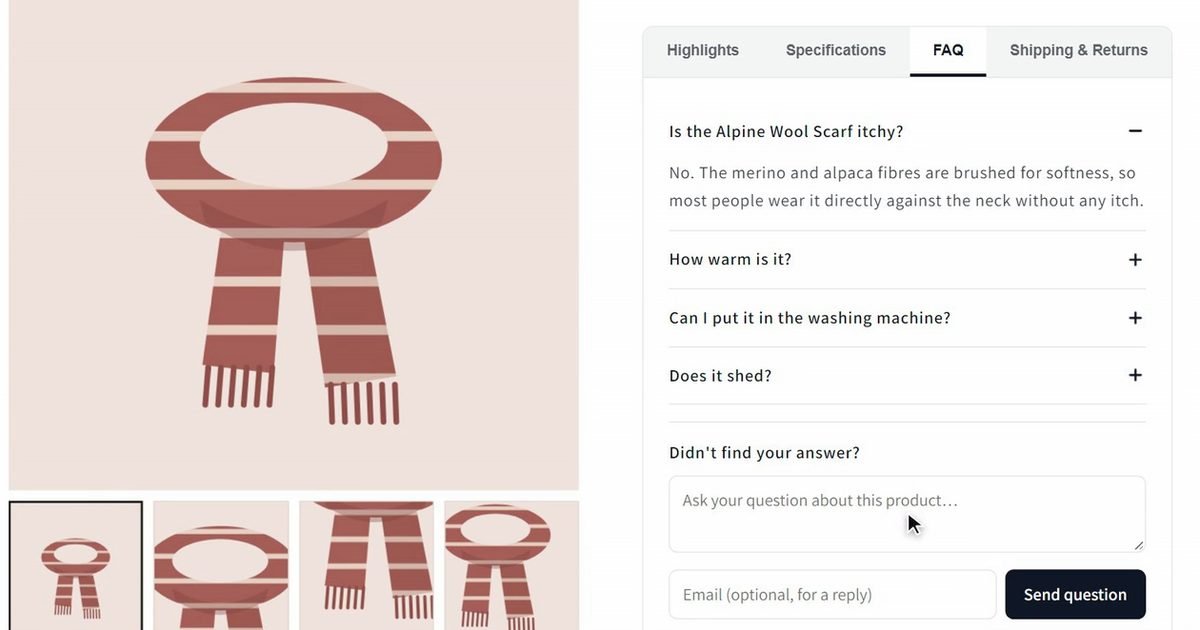
Short answer: for store policies, add a page with Shopify's free Collapsible content section. For questions about each product, add a Collapsible row to the product template and fill it from a product metafield, or use an app that writes and shows a FAQ for every product.
Every product gets the same few questions before someone buys. Is it itchy? Does it fit a 15-inch laptop? Can it go in the washing machine? When the answer isn't on the page, shoppers either email you and wait, or leave and buy from a store that answered.
Store FAQ or product FAQ?
A store FAQ answers questions about your business: shipping times, returns, payment, how to contact you. It's the same for every product, so it lives on its own page.
A product FAQ answers questions about one item: what it's made of, how it fits, what it works with, how to care for it. Those answers differ for every product, so they belong on the product page, next to the buy button. Most stores have the first and are missing the second.
Method 1: A store FAQ page with the Collapsible content section
Dawn and the other free Shopify themes include a Collapsible content section: a list of questions that open when clicked. Paid themes usually have the same thing under a similar name.
- In your Shopify admin, go to Online Store → Pages and add a page called FAQ. Leave the content empty and save.
- Go to Online Store → Themes and click Customize.
- In the page selector at the top, choose Pages, then Create template. Name it
faq. - Click Add section, choose Collapsible content, and add one row per question with its answer. Save.
- Back in Pages → FAQ, set Theme template to
faqand save. - Link the page from your footer menu (Content → Menus) and from your order confirmation emails.
This handles policy questions well and costs nothing. It doesn't help with product questions: shoppers won't leave a product page to search a separate FAQ for something about that one item.
Method 2: A different FAQ on each product with metafields
The product page in Dawn has a Collapsible row block. On its own it shows the same text on every product. Connect it to a metafield and each product shows its own FAQ.
- Go to Settings → Custom data → Products and click Add definition. Name it FAQ, choose the type Rich text, and save.
- Open a product. In the Metafields card at the bottom, fill the FAQ field: each question in bold, then a one- or two-sentence answer. Save, and repeat for each product.
- In Online Store → Themes → Customize, choose Products → Default product.
- In the Product information section, click Add block → Collapsible row. Set the heading to FAQ.
- Next to Row content, click the Connect dynamic source icon and pick Product → FAQ. Save.
It's free and it's yours. The cost is time: good product questions differ for every item, so 50 products means writing 200 to 300 answers by hand, and keeping them right when products change. Check a product whose field is still empty too: depending on the theme, the FAQ row may show with nothing inside.
Method 3: FAQs written for every product with Zutomatic
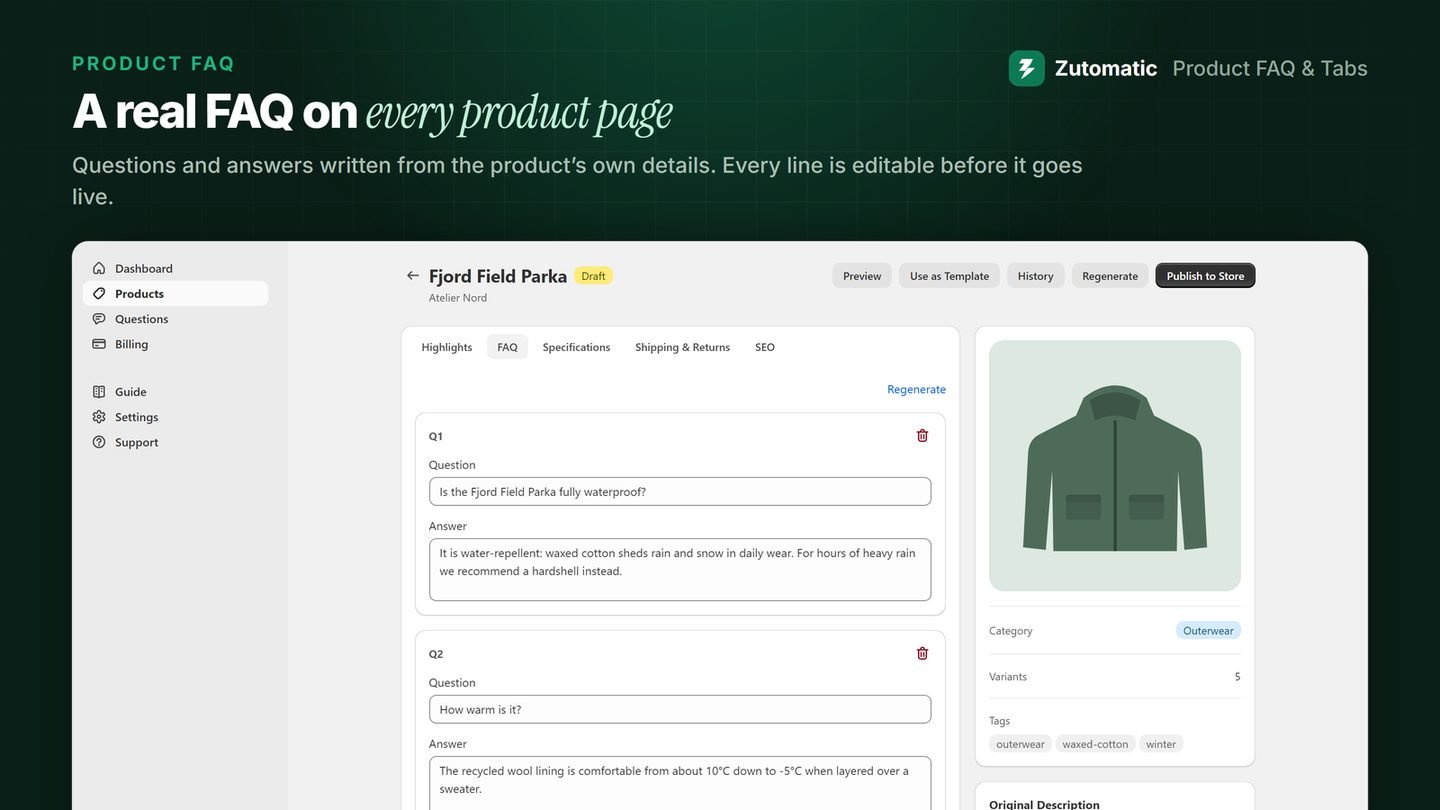
Zutomatic: Product FAQ & Tabs is a Shopify app that writes a FAQ for each product from the details you already have: title, description, options, type and tags. It also writes highlights, a specifications table, shipping notes and the SEO title and meta description.
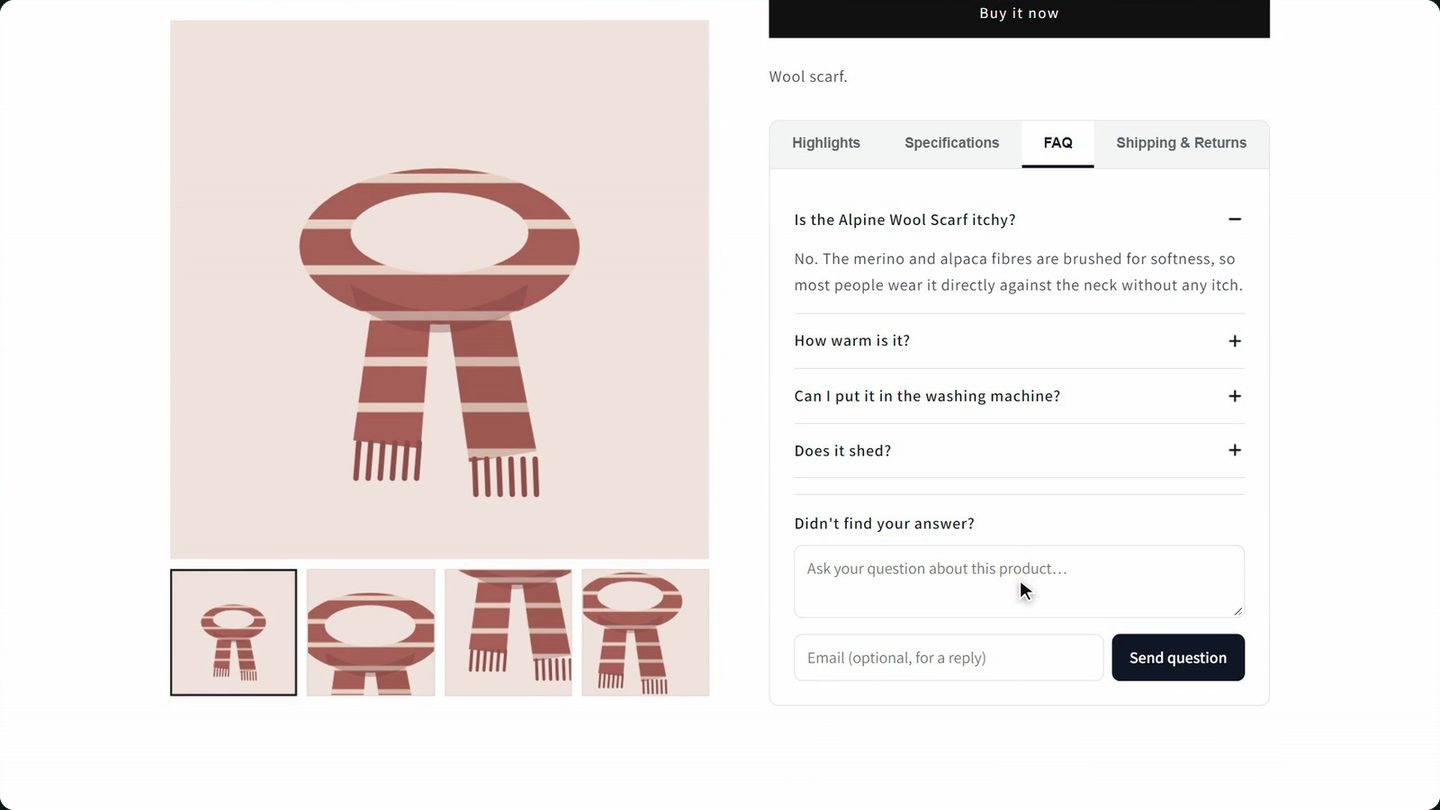
- Install Zutomatic: Product FAQ & Tabs from the Shopify App Store. The free plan covers 10 products.
- Open a product in the app and click Generate AI Content. You get four to six questions written for that kind of product: care and materials for clothing, compatibility for electronics, ingredients for food.
- Read the answers and fix anything that isn't right. Nothing reaches your store until you click Publish to Store.
- In Online Store → Themes → Customize → Default product, click Add block, and under Apps choose Zutomatic FAQ Accordion (or Zutomatic Product Tabs for the FAQ inside tabs). Save.
- On a paid plan, generate for your whole catalog at once and review as you go.
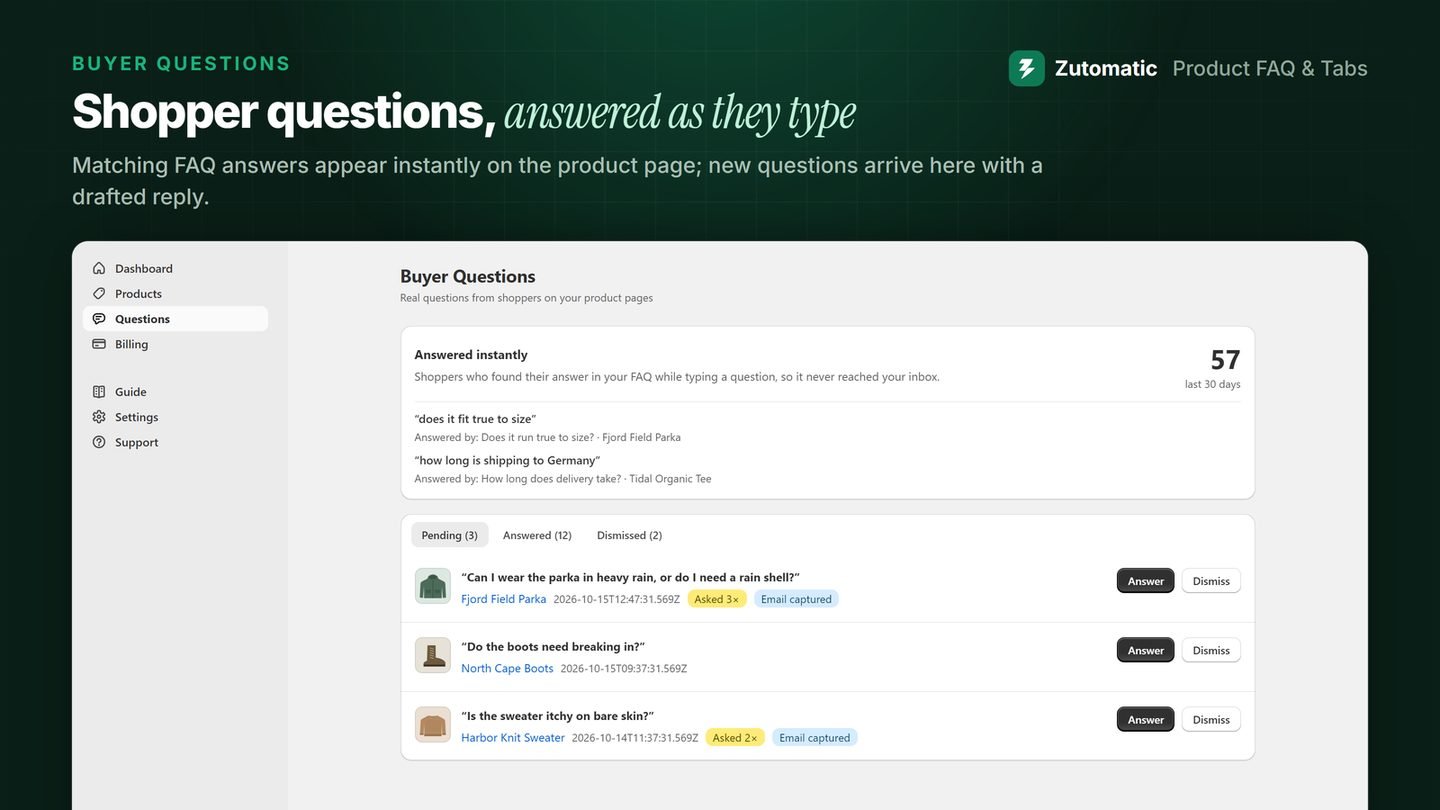
Below the FAQ, shoppers can type their own question. While they type, matching answers from the FAQ appear, so many never need to send it. Questions the FAQ can't answer land in the app's inbox with a drafted reply, and once you publish the reply it joins that product's FAQ.
AI answers are only as good as your product data. If the description doesn't mention a material or a size, add it to the product first, or correct the answer before publishing.
How to write a product FAQ that sells
Answer the questions that block the purchase
Good product FAQs remove doubt; they don't repeat the description. Think about what makes someone hesitate:
- Fit and size: Does it run small? What size is the model wearing?
- Compatibility: Does it fit my phone, my bike, my bed frame?
- Materials: Is it real leather? Waterproof or only water-resistant?
- Care: Washing machine or hand wash? Dishwasher safe?
- Delivery exceptions: Does this bulky item ship to my country?
Answer in the first word
"Yes, it fits laptops up to 15.6 inches" beats a paragraph about versatility. One or two sentences, with a number where you can.
Use your customers' words
Your best questions are in your inbox, your chat history and your reviews. If a question came up twice, it deserves a place in the FAQ.
Be honest about limits
"Hand wash only" loses fewer sales than a return. Honest answers build the trust that makes the next sale easier.
Which method should you choose?
| Collapsible content page | Collapsible row + metafield | Zutomatic | |
|---|---|---|---|
| Best for | Store policies | A few products | Every product |
| On the product page | No, separate page | Yes | Yes |
| Different per product | No | Yes | Yes |
| Who writes the answers | You | You, per product | AI, you review |
| Shopper question box | No | No | Yes, with instant answers |
| Cost | Free | Free | Free for 10 products |
Every store benefits from a FAQ page for policies, and Method 1 does that for free. A handful of products can be covered by hand with Method 2. Once your catalog grows past a dozen products, writing and maintaining a FAQ per product is where an app saves real time.
Selling on Wix too? See how to add an FAQ to Wix product pages.